Discover
Identify the patient and the eligible records within the healthcare product.
Healthcare interoperability
An ABDM integration for an existing Hospital Management System, built around ABHA, care contexts, consent-led exchange, secure callbacks, and FHIR-based records.
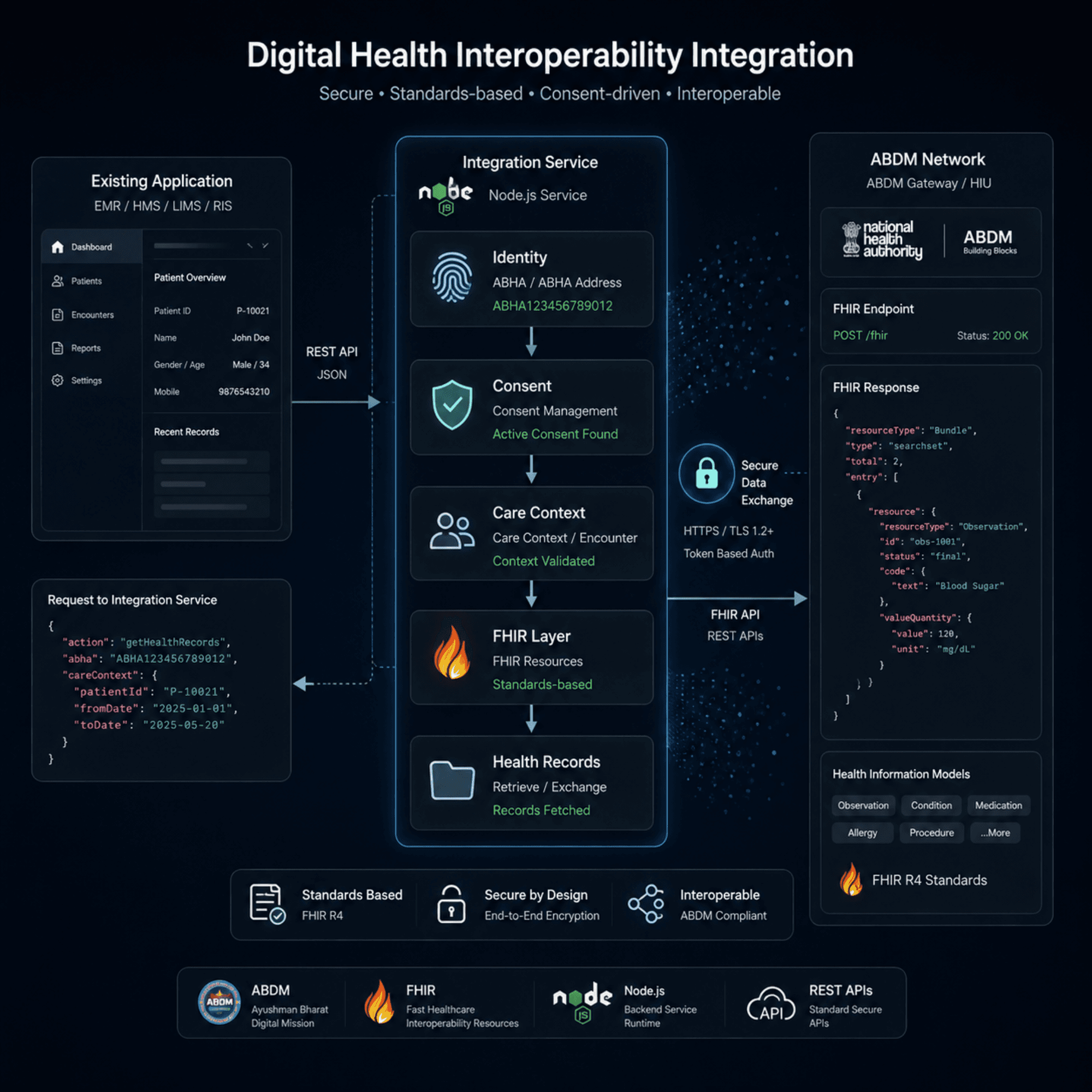
An integration shaped around the patient journey
The context
Developed ABHA creation, patient discovery, consent management, care context linking, and FHIR-based health record exchange.
Implemented HIP-HIU workflows and integrated multiple ABDM sandbox and production APIs.
Delivered a secure, standards-compliant solution that improved interoperability and supported digital healthcare transformation.
Consent-led exchange
Identify the patient and the eligible records within the healthcare product.
Connect the relevant care contexts to the patient journey.
Request and respect the patient’s permission before data moves.
Exchange authorised records through the required FHIR-based workflow.
Integration surface
ABHA Creation
Patient Discovery
Consent Request
Health Record Sharing
FHIR Resources
Care Context Linking
Callbacks
Audit Logs
Built in layers
Each layer supports a dependable exchange without moving the healthcare product away from its real operational context.
Implementation decisions
Implemented reusable resource builders following ABDM specifications.
Developed secure asynchronous processing with retry mechanisms.
ABDM integration guide
An ABDM integration can include ABHA creation or verification, HIP and HIU onboarding, care-context linking, consent workflows, secure callbacks, and FHIR-based health-record exchange. The exact scope depends on the healthcare product and the ABDM services it needs to support.
A HIP integration maps the hospital or clinic's records to the required healthcare-data format, links eligible care contexts, handles consent notifications, and serves approved health information through secure asynchronous workflows. Testing the complete callback and consent journey in the ABDM Sandbox is essential before production onboarding.
In the federated health-record framework, the ABDM Gateway helps authenticate connected systems and route asynchronous communications. It works with consent-management services and registries; participating HIPs and HIUs retain responsibility for their own systems and authorized data handling.
Federated architecture means health records remain with the systems that manage them instead of being copied into one central database. Information is exchanged only when a patient has granted the relevant consent, enabling interoperable care while keeping participating systems independently operated.
Start with credentials and environment configuration, callback URL reachability, token handling, request and response validation, care-context status, consent-state transitions, and FHIR payload validation. Reproduce the complete workflow with Sandbox test data and retain safe, non-sensitive logs for diagnosis.
The result
Successful ABDM integration.
FHIR-compliant healthcare exchange.
Secure consent-based data sharing.
Digital health interoperability.
Scalable healthcare integration.
Building healthcare software?